
Most women have stood in a store holding two pieces, one feeling fresh and exciting, the other feeling quietly reliable, and wondered which was actually worth the investment. Understanding what is timeless vs trendy fashion is not about picking a side. It is about knowing how each category functions in your wardrobe and using that knowledge to dress with confidence every single day. When you can tell the difference at a glance, shopping becomes less overwhelming and your closet starts working harder for you.
Table of Contents
- Key takeaways
- What makes timeless fashion truly last
- How trends work and why they matter
- How to spot the difference while shopping
- Building a wardrobe that balances both
- My honest take on the timeless vs trendy debate
- Discover your signature style with Thechiccollectionco ✨
- FAQ
Key takeaways
| Point | Details |
|---|---|
| Timeless pieces outlast trends | Classic silhouettes, neutral colors, and quality fabrics keep pieces wearable for 5 to 10 years or more. |
| Trends cycle fast | Most fashion trends last only 3 to 18 months, so buy them at lower price points to avoid wardrobe regret. |
| Silhouette reveals staying power | Extreme proportions date quickly; balanced fits and clean lines tend to remain relevant across seasons. |
| Cost-per-wear matters | A $200 blazer worn 100 times beats a $40 top worn twice. Quality investment pays off over time. |
| Both categories belong together | Anchoring your wardrobe in timeless pieces and layering in trends creates a look that feels personal and fresh. |
What makes timeless fashion truly last
Timeless fashion is not simply about being old or conservative. It refers to pieces whose design, proportion, and construction hold up beautifully across decades without looking like a relic from any specific era.
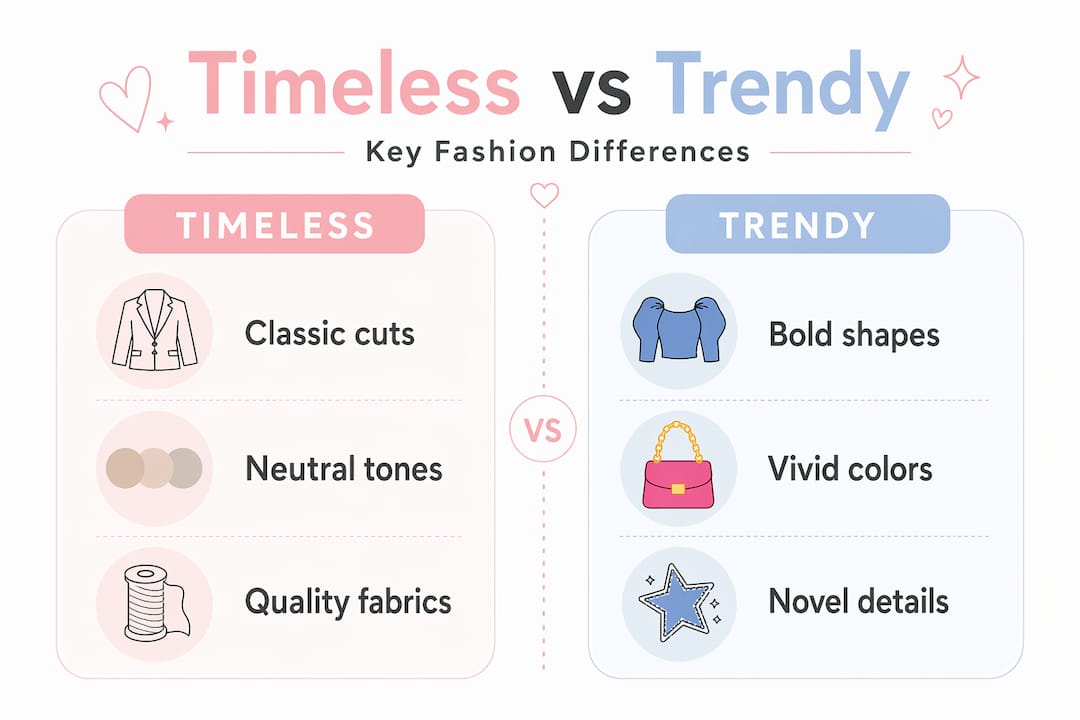
The defining characteristics are easy to spot once you know what to look for. Classic silhouettes sit close to the body without extreme proportions. Neutral and versatile color palettes, think ivory, navy, camel, and black, make pieces easy to combine with almost anything. Quality materials, whether that is a tightly woven wool, a substantial cotton, or a supple leather, give garments a visual weight that reads as polished rather than cheap.
The trench coat is perhaps the most cited example of timeless fashion, and for good reason. It has appeared on runways and city streets every decade since the early twentieth century, subtly updated in proportion but always recognizable. The white cotton T-shirt, the tailored blazer, the straight-leg trouser: real closet audits show that women wear these pieces for 15 years or more, often citing them as the most-reached-for items they own.
There is one nuance worth understanding here. Many perceived timeless pieces are actually what experts call modern classics, pieces that maintain timeless construction and proportions but update small details like pocket placement, collar shape, or hem finish to prevent a wardrobe from feeling frozen in a past decade. A blazer from five years ago with slightly padded shoulders might still feel current if the overall cut is clean and the fabric is excellent. That is the beauty of the modern classic category: it gives you longevity without looking stiff.
Pro Tip: When evaluating a piece as timeless, ask yourself whether it could have been worn a decade ago and could plausibly still be worn a decade from now. If the answer to both is yes, you are likely looking at a true classic.
Here is a quick reference for how the two categories compare at the point of purchase:
| Trait | Timeless piece | Trendy piece |
|---|---|---|
| Silhouette | Balanced, proportional | Exaggerated or extreme |
| Color palette | Neutral or enduring classics | Seasonal or statement hues |
| Material quality | Substantial, durable fabrics | Often lightweight or fast-fashion materials |
| Price positioning | Higher cost, longer wear | Lower cost, shorter life span |
| Styling flexibility | Pairs with almost everything | Works within a specific trend cycle |
How trends work and why they matter
Trendy fashion gets dismissed far too quickly. Yes, it fades. But it also does something timeless fashion simply cannot: it signals that you are engaged with the world right now, paying attention to culture, art, and the moment you are living in. That energy is worth something.
Fashion trends typically rotate every 3 to 6 months, with individual trends lasting anywhere from 3 to 18 months depending on how widely they spread. The Y2K revival, for example, ran for nearly 18 months before saturation set in. Some trends operate on an even grander scale. A mathematical analysis of 37,000 women’s garments spanning over 150 years confirmed a consistent 20-year cycle in fashion features, explaining why bell-bottoms, mini skirts, and wide-lapel blazers keep reappearing with each new generation.
What drives this cycling? Fashion evolution is shaped by the social desire to both fit in and stand out, creating a constant oscillation where popularity builds, peaks, exhausts itself, and then revives once enough time has passed. Understanding this rhythm takes the sting out of watching a trend fade. It was always going to.
The key elements of trendy fashion to recognize are:
- Distinctive color or print of the moment. Think cobalt blue one season, polka dots the next.
- Exaggerated proportions. Oversized shoulders, micro-mini lengths, cropped hemlines above the natural waist.
- Statement hardware or embellishment. Chunky gold chains, rhinestone detailing, logo-forward branding.
- Material novelty. PVC panels, textured boucle from a specific brand’s viral moment, or sheer mesh overlays.
- Rapidly shifting silhouettes. The shift from skinny to wide-leg denim is a textbook example.
None of these features are inherently bad. They make fashion exciting. But they do signal a limited wearable window.
Pro Tip: Reserve your higher budget for timeless pieces and set a clear spending cap for trend-driven items. When a piece will likely only be worn for one or two seasons, the lower the price point, the less the regret.
How to spot the difference while shopping
This is where the knowledge becomes practical, because theory is only useful when you are standing in a dressing room deciding whether to spend your money.
The most reliable single clue is silhouette extremes. Pieces with exaggerated proportions, whether dramatically cropped, oversized beyond function, or built around exaggerated shoulders, tend to date quickly. A cropped jacket that sits two inches above the waistband feels fresh in the season it launches and nostalgic within three years. Compare that to a hip-length, single-button blazer in camel wool. That piece does not belong to any specific year.
Here is a numbered process for evaluating any purchase:
- Check the silhouette. Is it a balanced, proportional cut or does it lean on extreme volume, length, or fit to make its statement?
- Feel the fabric. Thin polyester or loosely woven blends often signal a fast-fashion item built for a single season. Substantial fabric signals longevity.
- Look at the color. Is this a neutral you already wear, a classic like navy or burgundy, or is it specifically “the color of this season”?
- Consider the styling options. Can you imagine this piece with at least five things already in your closet, or does it only work within a very specific look?
- Run the cost-per-wear calculation. Cost-per-wear divides the price of a piece by the estimated number of times you will wear it. A $180 dress worn 60 times costs $3 per wear. A $60 dress worn four times costs $15 per wear.
Overemphasizing price without considering quality and wear frequency is one of the most common mistakes women make when building a wardrobe. The most expensive piece in your closet is the one you never wear.
Pro Tip: If you are torn on a trendy piece, try the 30-day rule. If you can still picture wearing it in 30 different settings a month from now, it earns its place. If you cannot, leave it behind.
Building a wardrobe that balances both
The most elegant wardrobes are never entirely one category. They use timeless pieces as anchors and trendy pieces as accents, the way a beautifully cut room uses neutral walls to make artwork pop.
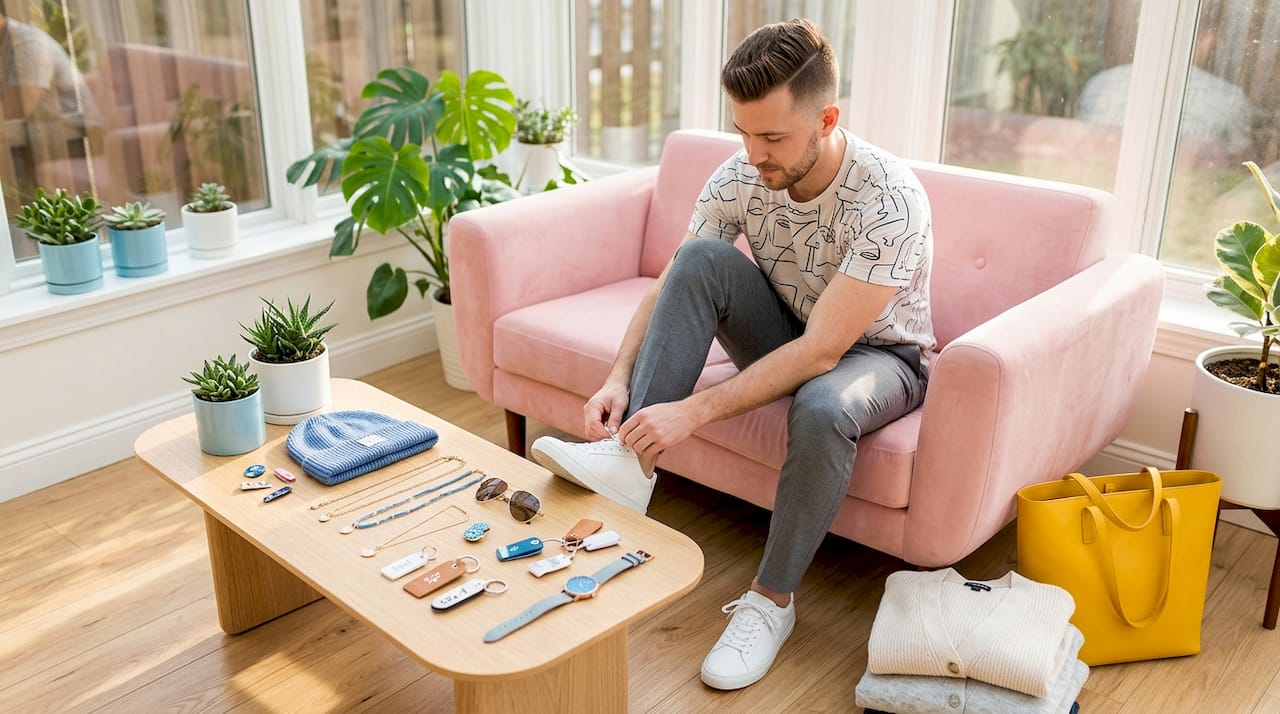
Think about what this looks like in practice. A tailored wide-leg trouser in ivory, a clean white linen shirt from the classic shirts collection, and a polka-dot silk scarf tied to your bag. The first two pieces will serve you for years. The scarf reflects summer 2026’s trend of playful print accents on neutral bases without requiring you to rethink the entire outfit once the trend passes.
Here are practical ways to keep this balance working season after season:
- Build your core around neutral, quality separates: a structured blazer, clean trousers, a fitted knit, a crisp button-down.
- Let trends live in your accessories and accent pieces. A trendy bag, a statement earring, a bold lip color. These are lower-commitment ways to feel current.
- Rotate seasonal trend pieces out of your main closet space to avoid visual noise and decision fatigue.
- Buy trendy pieces in fabrics that launder easily, since they will have a shorter active rotation.
- Prioritize fit above everything. A poorly fitting timeless piece still looks wrong. Fit is the one non-negotiable in both categories.
The sustainability angle matters too. Investing in fewer, better timeless pieces produces less waste than cycling through cheap trend items every few months. Your wardrobe becomes a curated reflection of who you are rather than a record of every passing moment.
My honest take on the timeless vs trendy debate
I have spent years watching how wardrobes evolve, and the one thing I keep coming back to is this: the timeless versus trendy framework is useful, but it can become a trap if taken too literally.
I have seen women so focused on buying only “classics” that their closets felt museum-like, technically correct but with no joy in them. And I have seen the opposite, women chasing every micro-trend until they felt overwhelmed by clothes that no longer felt like themselves. Neither extreme serves you.
What I have learned is that real style is not about the category a piece falls into. It is about whether the piece is genuinely you, whether it fits well, whether it makes you feel the way you want to feel when you walk into a room. Some women feel most like themselves in a clean navy blazer and tailored trousers. Others feel most alive in a print-forward dress that belongs entirely to this exact season. Both are correct.
The more honest question is not “is this timeless or trendy?” but “will I still love this in six months?” That is a question only you can answer, and learning to trust that answer is the actual skill worth developing. The framework in this article gives you a vocabulary for thinking it through. Your instincts give you the final word.
— John
Discover your signature style with Thechiccollectionco ✨
You now have the clarity to shop with real intention, and Thechiccollectionco is the perfect place to put that knowledge to work. The curated collections are thoughtfully designed to hold that elegant balance between timeless construction and fresh, current details. Whether you are drawn to a beautifully structured elegant dress built on a classic silhouette, or a sculptural heart-shaped leather handbag that doubles as a statement accessory, every piece is priced to make quality fashion accessible. Free delivery on every order, a secure money-back guarantee, and 24/7 support make the experience as graceful as the pieces themselves.
FAQ
What is the main difference between timeless and trendy fashion?
Timeless fashion features balanced silhouettes, quality materials, and neutral palettes that remain wearable across decades, while trendy fashion is defined by seasonal details, extreme proportions, and a shorter lifespan of roughly 3 to 18 months.
Is timeless style worth it for everyday wear?
Yes. Timeless pieces deliver a lower cost-per-wear over time because they stay relevant season after season, making them a smarter financial and stylistic investment than trend-driven items purchased repeatedly.
How do you choose timeless fashion when shopping?
Look for balanced proportions, neutral or classic colors, substantial fabrics, and versatile styling options. If a piece works with at least five items already in your closet and avoids extreme design details, it is likely a timeless buy.
Can you mix timeless and trendy pieces in one outfit?
Absolutely. The most polished approach is to anchor your outfit in a timeless base, such as tailored trousers or a classic blazer, and add a single trendy accent through accessories, a scarf, or a statement shoe.
How often do fashion trends change?
Fashion trends typically rotate every 3 to 6 months, with individual trends lasting anywhere from 3 to 18 months. Some style features follow a longer 20-year cycle, reappearing with each new generation in a refreshed form.
Recommended
- Retro-Style Double-Pocket Shoulder Bag – The Perfect Everyday Commuter – The Chic Collection Co
- Clothes – The Chic Collection Co
- Graceful Allure: Elegant Pleated Backless Sleeveless Maxi Dresses – The Chic Collection Co
- Relogio Masculino Ultra-Thin Luxury Men’s Watch – Classic, Stylish & C – The Chic Collection Co