
You’ve done it too. You’ve brought home a dress that looked stunning on the hanger, slipped it on, and felt vaguely disappointed. The waist sat too high, the shoulders pulled, the hem skimmed the wrong part of your calf. And yet, you convinced yourself it was close enough. This is the quiet trap that keeps millions of women from experiencing their clothes the way they deserve to. Understanding why tailoring matters in women’s fashion is not about perfectionism. It is about recognizing that your body is the constant, and your clothes should conform to it, not the other way around.
Table of Contents
- Key Takeaways
- Why fit matters more than you think
- Common tailoring adjustments and why they matter
- Tailoring as a strategic wardrobe investment
- How to find and work with a skilled tailor
- Tailored clothing vs. ready-to-wear: a real comparison
- My take on why tailoring changes everything
- Step into your most confident silhouette ✨
- FAQ
Key Takeaways
| Point | Details |
|---|---|
| Fit transforms confidence | Research shows that proper garment fit significantly improves psychological self-confidence compared to loose, off-the-rack alternatives. |
| Alterations are maintenance, not luxury | Common adjustments like waist shaping and hem refinement are a normal part of building a polished, lasting wardrobe. |
| Tailoring extends garment life | A well-fitted, altered piece lasts longer through body changes and trend cycles than a poorly fitting purchase. |
| Finding the right tailor is a skill | Knowing what to communicate and what to look for in a tailor directly shapes the quality of your results. |
| Tailored vs. ready-to-wear is a value equation | The upfront cost of alterations pays back in longevity, confidence, and fewer wasted purchases. |
Why fit matters more than you think
The difference between a garment that fits and one that almost fits is not subtle. It is visible in every photo, felt in every meeting, and noticed in every mirror. Garment fit significantly improves wearer self-confidence compared to standard loose-fit clothing, with experimental data showing a significant psychological effect across a sample of 256 participants. That is not a small finding. That is science confirming what your gut already knows.
When fabric pulls, gaps, or collapses in the wrong places, it creates visual noise. Your eye is drawn to the disruption rather than to you. A tailored silhouette, by contrast, moves with your body and reads as intentional, polished, and graceful. It communicates control without effort.
The psychological benefits run deeper than appearance alone. Women who wear properly fitted clothing often report improved posture because the garment supports the body rather than fighting it. Fit impacts self-confidence in ways that go beyond aesthetics, influencing mood, focus, and even how others perceive your authority in a room.
Here is what proper fit actually addresses in practice:
- Shoulder seams that sit at the exact edge of the shoulder, not drifting down the arm or cutting across the neck
- Waistlines that define your natural shape without pinching or creating horizontal creases
- Hem lengths calibrated to your height and proportions, not an averaged standard
- Sleeve lengths that end cleanly at the wrist, not mid-forearm or past the thumb
- Chest and bust shaping that lies flat without pulling or gaping at buttons
Pro Tip: When trying on a new garment, check the shoulder seams first. If those sit correctly, almost every other adjustment becomes possible. If they don’t, the alteration cost rises significantly.
Common tailoring adjustments and why they matter
Off-the-rack clothes cannot account for the individual variations that make every body unique. Standard sizing is built on averaged measurements, which means that even if a garment fits your bust, it may miss your waist by two inches. This is not a flaw in your body. It is a limitation of mass production.
The most common alterations women request fall into a predictable and manageable category. Alterations like sleeve adjustment and waist shaping dramatically improve comfort, silhouette, and overall garment lifespan. They are not a sign of poor craftsmanship in the original piece. They are simply how clothes become yours.

Here is a comparison of what an alteration actually changes:
| Alteration | Before | After |
|---|---|---|
| Waist shaping | Boxy, undefined silhouette | Nipped waist that honors your natural shape |
| Hem adjustment | Awkward length that interrupts the leg | Clean line at the most flattering point |
| Shoulder adjustment | Seam droops or cuts | Sits precisely at the shoulder edge |
| Sleeve shortening | Bunches at the wrist or hides the hand | Ends cleanly for a refined, intentional look |
| Dart adjustment | Fabric pulls or collapses at the chest | Lies smooth and flat, draping beautifully |
One thing most women miss is that tailoring is not a one-time event. Bodies change through the seasons of life, whether through fitness shifts, pregnancy, aging, or simply evolving posture. Tailoring aligns garments with your evolving body and style preferences, which means the blazer you loved at 30 can still love you at 40.
- Always bring the shoes you plan to wear to hem appointments
- Request that your tailor mark alterations while you are in the garment, not by measuring it flat
- Ask for a basted fitting before final stitching on significant alterations
Pro Tip: Before purchasing an expensive piece, ask yourself whether it fits your shoulders and length. If yes, a tailor can handle the rest for a fraction of the garment’s cost.
Tailoring as a strategic wardrobe investment
There is a mindset shift that separates women who dress well from women who spend a lot on clothes. The former understand that fewer, better pieces worn confidently outperform a closet bursting with near-misses. Tailoring is the mechanism that makes this possible.
Here is how to reframe tailoring as the intelligent wardrobe strategy it actually is:
-
Reduce waste by buying with intention. When you know a piece can be adjusted, you stop buying replacements for things that simply need refinement. Tailoring saves you from buying multiple ill-fitting garments by enabling investment in fewer, higher-quality, and uniquely styled pieces.
-
Extend the life of pieces you already love. A dress that no longer fits can be taken in. A waistband that is too snug can be let out. Rather than discarding garments, tailoring gives them a second and third chapter.
-
Express your individuality beyond mass-market sizing. The custom clothing advantages go beyond fit. Tailoring changes clothes to support your unique proportions, closing the gap between what mass production offers and what your body actually needs.
-
Shift your cost-per-wear calculation. A $200 dress worn 40 times because it fits perfectly costs $5 per wear. A $80 dress worn twice because you never felt quite right in it costs $40 per wear. Tailoring tips the equation firmly in your favor.
-
Build a wardrobe that evolves with you. Expecting perfect off-the-rack fit is a psychological barrier that limits women from fully embracing tailoring. Releasing that expectation is the first step toward a genuinely sustainable and satisfying wardrobe.
How to find and work with a skilled tailor
Not all tailors are equal, and a mediocre alteration can actually damage a garment. Finding someone skilled and building a real relationship with them is one of the most underrated fashion investments you can make.
When you are searching for a tailor, look for these signs of genuine skill and professionalism. Ask to see examples of their work, particularly on garments similar to yours in fabric weight and construction. A tailor who specializes in women’s clothing will understand the nuances of darts, bias cuts, and delicate fabrics in ways a generalist may not.
- Visit with a specific garment in mind. Bring one piece to a first appointment rather than a pile. You will assess their communication, attention to detail, and understanding of your preferences without overwhelming the relationship early.
- Describe how you want to feel in the garment, not just how you want it to look. Saying “I want this to feel secure across the shoulders without restricting my arms” gives a tailor far more to work with than “make it fit better.”
- Get a price breakdown before any cutting begins. Reputable tailors provide clear estimates. Surprises at pickup are a red flag.
- Give honest feedback at fittings. A good tailor wants to know if something still pulls. They are not offended. They are problem-solving.
- Return to the same tailor when possible. Over time, they learn your body, your preferences, and your lifestyle. That knowledge becomes its own kind of luxury.
Tailored clothing vs. ready-to-wear: a real comparison
The difference between a tailored garment and its ready-to-wear counterpart is not always about price at the point of purchase. It becomes visible over time, in photographs, and in the way you carry yourself.
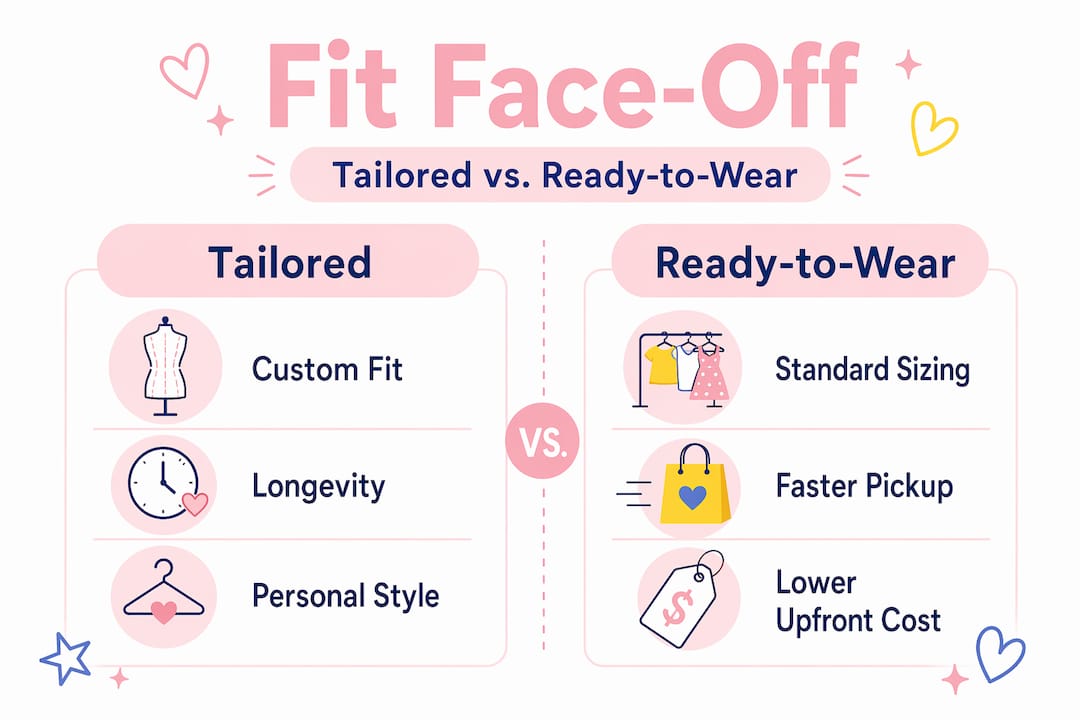
| Quality | Ready-to-Wear | Tailored |
|---|---|---|
| Silhouette | Averaged proportions | Specific to your body |
| Fabric drape | May pull or collapse | Flows with your movement |
| Longevity | Often discarded after poor fit | Worn repeatedly and confidently |
| Confidence impact | Variable and often deflating | Consistent and empowering |
| Professional impression | Inconsistent | Polished and authoritative |
A well-tailored garment provides a polished, professional look that commands respect without a single word spoken. That is not hyperbole. It is the quiet power of clothes that genuinely fit.
“Tailored garments communicate authority and control subtly, enabling the wearer to focus on presence rather than on managing their clothing.”
When you stop adjusting your hem, tugging at your waist, or crossing your arms to hide a gaping button, something powerful happens. The celebration becomes you, not the clothes.
My take on why tailoring changes everything
I’ve spent years watching women walk into rooms and immediately shrink because something about what they were wearing didn’t feel right. A sleeve too long, a waist too loose, a neckline that kept drifting. The garment was wearing them, rather than the other way around.
What I’ve found consistently is that most women believe tailoring is reserved for special occasions or expensive wardrobes. In my experience, that belief costs more than any alteration ever would. The $35 hem on a $60 dress can transform it into something you reach for every week. The waist shaping on a blazer can shift how you walk into every boardroom or brunch for years.
What I think gets overlooked is the identity dimension. Tailoring supports women in leadership not because it makes them look “dressed up,” but because it removes every small distraction and signals to the wearer and to the room that she has considered her presence. That confidence is not manufactured. It is real, and it is earned through clothes that actually work for her body.
The women I’ve seen embrace tailoring don’t wear more clothes. They wear better ones, more often, with more joy. That is the shift worth making.
— John
Step into your most confident silhouette ✨
You now know exactly why tailoring matters in women’s fashion, and the next step is having pieces worth tailoring. At Thechiccollectionco, every garment in our curated collection is chosen with fit and longevity in mind. These are not throwaway pieces. They are the kind of garments that reward a skilled tailor’s attention and grow more beautiful when adapted to your unique proportions.
Our women’s dress collection features silhouettes in fabrics that respond beautifully to waist shaping, hem adjustments, and darting. Browse our curated apparel selection for pieces that form the elegant backbone of a tailored wardrobe. And for days when a garment needs a little extra foundation, our waist trainer bodyshaper and thong bodysuit shaper create the smooth canvas every tailored piece deserves. Every order ships free, and your satisfaction is backed by our money-back guarantee.
FAQ
Why does tailoring matter so much for women’s fashion?
Tailoring matters because fit directly impacts self-confidence and how others perceive you. Off-the-rack sizing cannot accommodate individual proportions, so tailoring closes the gap between what’s available and what actually works for your body.
What are the most common tailoring adjustments for women?
The most common alterations include hem length, waist shaping, shoulder adjustment, sleeve shortening, and dart modification. These changes improve both comfort and silhouette while preserving the original design of the garment.
Is tailoring worth the cost for everyday clothing?
Yes, because tailoring extends the lifespan of a garment and dramatically increases how often you wear it. Tailoring enables investment in fewer, higher-quality pieces rather than buying multiple ill-fitting replacements.
How do I know if a tailor is skilled enough for my clothes?
Ask to see examples of completed alterations, bring a specific garment to your first appointment, and request a detailed price estimate before work begins. A skilled tailor will ask questions about how you want to feel in the garment, not just how you want it to look.
Can tailoring help women who struggle to find ready-to-wear fits?
Absolutely. Standard sizing is generalized and cannot account for the natural variations in women’s bodies. Tailoring creates flattering silhouettes aligned with your unique proportions, regardless of the size or shape you begin with.
Recommended
- Salome Invisible Thong Bodysuit – The Ultimate Daily Shaper – The Chic Collection Co
- Fashion Heart‑Shape PU Leather Handbag – Women’s Top Handle & Crossbod – The Chic Collection Co
- Fashion Heart‑Shape PU Leather Handbag – Women’s Crossbody Bag – The Chic Collection Co
- Clothes – The Chic Collection Co