
You walk into an interview. Before you say a word, the room has already formed an opinion. The role of accessories in your professional image is far more decisive than most people realize. Accessories are not decorative afterthoughts. They are strategic signals, communicating your attention to detail, your sense of self, and your respect for the context you are entering. This guide will show you how to use them with intention, so every piece you wear works in your favor.
Table of Contents
- Key takeaways
- The role of accessories professional image: first impressions and perception
- Choosing accessories for your work environment
- Styling techniques that project confidence
- Building your professional accessory wardrobe
- My honest take on accessories and professional success
- Discover your signature professional style
- FAQ
Key takeaways
| Point | Details |
|---|---|
| Accessories signal competence | Polished, intentional accessory choices increase perceived reliability regardless of the price tag. |
| Fit and intention outweigh cost | A well-chosen affordable piece reads more professionally than an expensive item worn carelessly. |
| Match accessories to your environment | Formal settings call for restraint; creative workplaces allow more expressive layering and texture. |
| Use the “one star” rule | One statement accessory supported by quieter pieces communicates authority without visual noise. |
| Build a versatile staples collection | Timeless pieces like structured bags and classic jewelry deliver more style return than trend-chasing. |
The role of accessories professional image: first impressions and perception
There is a reason image consultants spend as much time on accessories as they do on clothing. Polished accessories signal competence and reliability before a single word is exchanged, and that perception shapes how colleagues, clients, and hiring managers respond to you throughout an interaction.
Think about what a structured leather bag communicates versus a stretched tote overflowing with receipts. Both carry your laptop. Only one tells the room you are organized and ready. Premium minimalist leather goods like a structured briefcase speak to competence more effectively than flashy branded pieces. The message is quiet, but it lands.
The importance of accessories in fashion has always been tied to social context. In professional settings, that context is about trust. A classic watch, clean and unscuffed shoes, and a well-chosen necklace all tell a story of care and preparation. Classic jewelry pieces like diamond studs, lariat necklaces, and elegant watches convey confidence and authority in corporate settings, and that association is not accidental.
What separates powerful dressing from ordinary dressing is intentionality. A well-fitting $80 blazer creates a stronger impression than an ill-fitting $500 one, and the same principle applies directly to accessories. The impact of accessories on perception is rooted in how much thought they appear to represent, not how much money they actually cost.
- Watches signal punctuality and professionalism without requiring explanation
- Structured handbags read as organized and polished across nearly every industry
- Clean, appropriate footwear anchors an entire outfit and often carries the most visual weight
- Minimal, refined jewelry adds finish without competing with the conversation
Pro Tip: Before your next important meeting or interview, lay your full outfit on the bed including every accessory. Step back and look at it as a whole. If one piece draws your eye more than your face would, reconsider it.
Choosing accessories for your work environment
Not all professional environments speak the same visual language, and the best accessories for a professional look in a law firm are not necessarily the best choice for a design studio. Understanding your workplace culture is the foundation of smart accessory decisions.
Formal business settings
In traditional business environments, less truly is more. Industry guidelines recommend keeping heels at or below three inches and avoiding chunky or noisy jewelry that draws attention away from your professionalism. Closed-toe shoes, a structured bag, and subtle gold or silver jewelry are the baseline. The goal is cohesion, not invisibility. You want your accessories to feel like a natural extension of your attire rather than a separate statement.
Business casual and creative environments
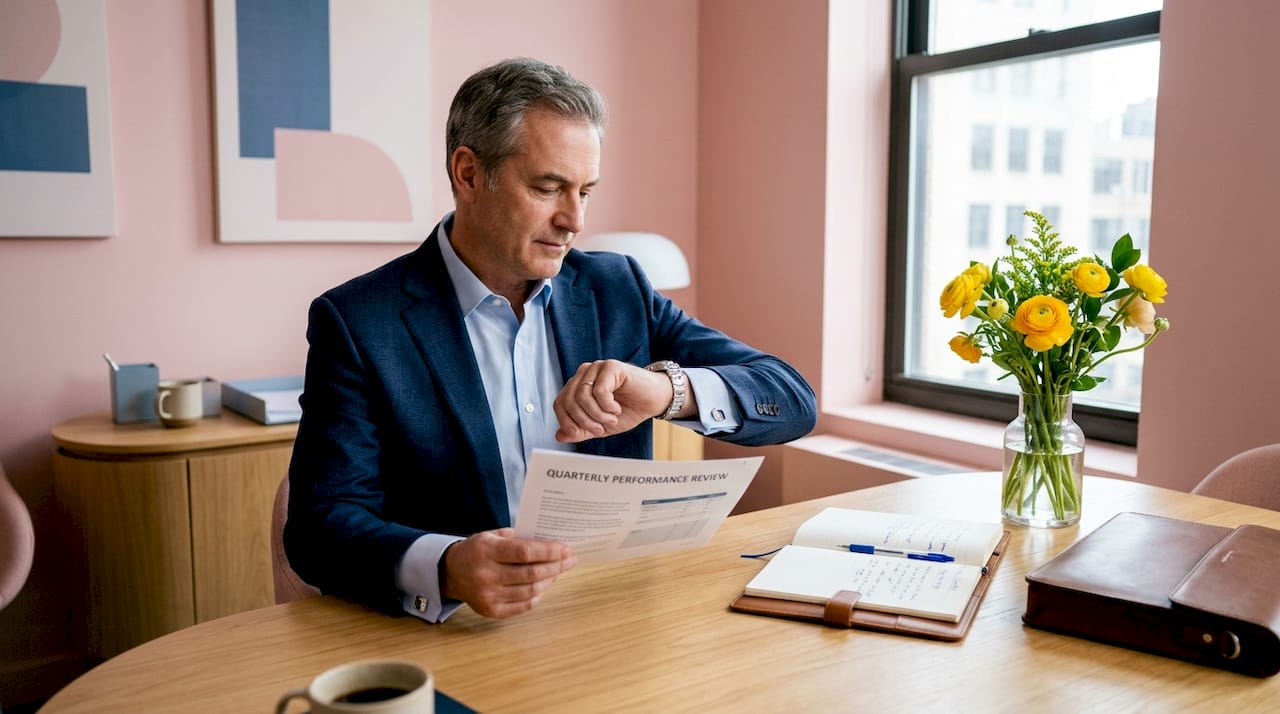
Business casual opens more doors. Bright pops of color in socks or pocket squares and textured accessories can modernize a look without undercutting your professional presence. In creative fields, accessories become a genuine expression of personal brand. A photographer might wear a bold sculptural ring. A brand strategist might reach for a printed silk scarf. These choices communicate personality, which in creative contexts is often seen as a professional asset.
| Environment | Recommended accessories | What to avoid |
|---|---|---|
| Business formal | Classic watch, structured bag, stud earrings, closed-toe heels | Chunky bangles, noisy jewelry, statement sunglasses indoors |
| Business casual | Layered necklaces, textured belts, loafers, colorful scarves | Overly casual bags, athletic wear accessories, excessive layering |
| Creative or startup | Bold rings, mixed metals, artistic bags, expressive shoes | Anything that distracts from work capability or function |
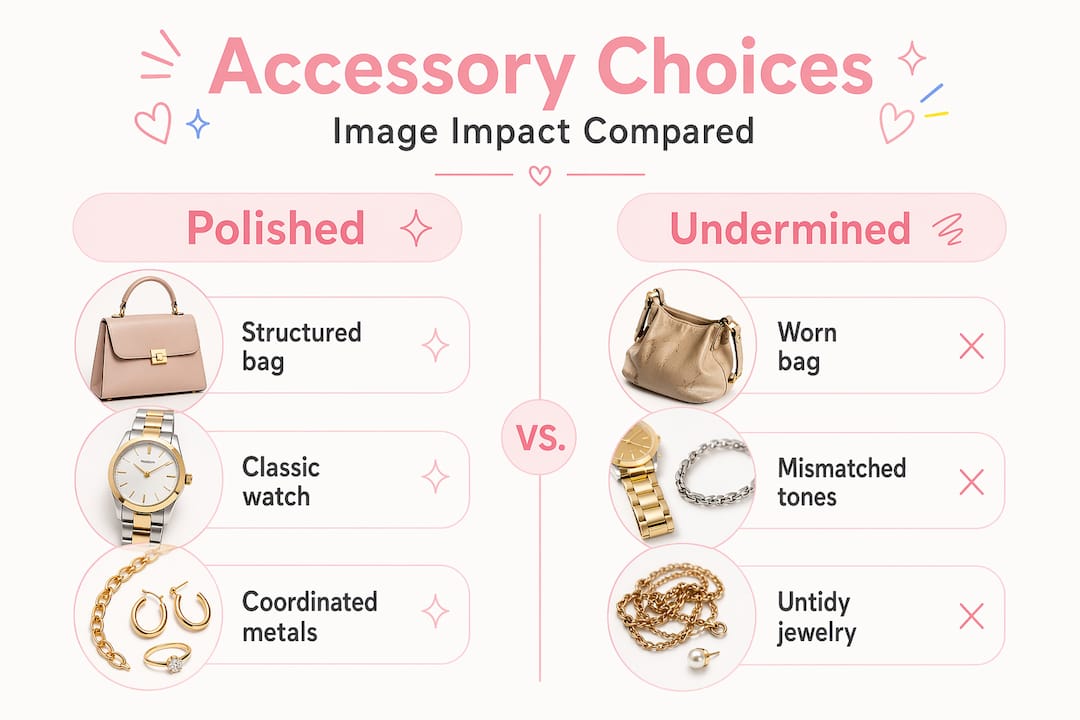
Common mistakes that undermine image include mismatching metal tones across multiple pieces, carrying a worn or dirty bag with an otherwise polished outfit, and wearing accessories that make noise during presentations. These details seem minor, but they register.
Pro Tip: When you are unsure about a new workplace’s culture, observe what the most respected person in the room wears for two weeks before making bold accessory choices. Mirror, then gradually distinguish.
Styling techniques that project confidence
Knowing how to use accessories for image is not just about what you choose. It is about how you compose them together. This is where accessories and professional style become genuinely expressive.
Color psychology in accessories
Warm-toned accessories project energy and approachability. Think amber, gold, cognac leather, and terracotta. These colors work well in client-facing roles where warmth signals welcome. Cool tones like silver, navy, slate, and black convey calm authority and focus. They are ideal for environments where you want to project precision and command.
You do not need to overhaul your wardrobe to apply this. A gold watch versus a silver one. A camel bag versus a black one. These small decisions compound into a clear visual message.
The one-star rule
Choosing a single statement accessory and letting everything else support it is one of the most effective principles in professional styling. Your “star” might be a sculptural earring, a bold bag, or an elegant watch. Once you have chosen it, every other piece should be quieter. This approach creates a clear focal point that feels polished and intentional rather than overwhelming.
Matching scale to your frame and outfit
Accessory scale relative to body frame and garment fabric weight is a detail most people overlook entirely. A delicate chain necklace disappears against a chunky wool blazer. An oversized pendant bag feels awkward against a sleek silk blouse. Matching weight to weight and scale to scale creates visual harmony that reads as effortless, even though it is entirely deliberate.
- Petite frames: opt for smaller, refined accessories that do not overpower your silhouette
- Taller or broader frames: medium to large accessories feel proportional and grounded
- Lightweight fabrics like silk or chiffon: pair with fine jewelry and slim leather goods
- Structured or heavier fabrics like wool or tweed: anchor with bolder, weightier pieces
Intentional accessory layering creates richness and tells a personal story in professional style, but it requires restraint. Two layered necklaces of different lengths reads as styled. Five reads as chaotic. The difference is discipline.
Building your professional accessory wardrobe
The most practical approach to accessories and professional style is building a small, intentional collection that works across multiple outfits and occasions rather than buying individual pieces reactively.
-
Start with four true staples. A quality watch, a structured bag, one pair of refined earrings, and clean versatile footwear. These four items will carry 80% of your professional looks without requiring you to think hard.
-
Choose versatility over trend. Timeless pieces like leather briefcases and classic jewelry deliver far more style return than fast fashion accessories. A trend piece works for one season. A well-chosen leather bag works for a decade.
-
Use accessories to refresh core outfits. The same navy blazer reads entirely differently with a silk scarf than it does with a pearl necklace. Accessories extend your wardrobe without expanding your closet. This is one of the most underutilized strategies in professional dressing.
-
Maintain your pieces consistently. Scuffed shoes, tarnished rings, and fraying bag straps undo all the effort of a polished outfit. Clean your leather goods seasonally, polish metals regularly, and replace worn items before they become visible. You can explore elegant office attire to see how accessories pair with different professional looks.
-
Edit before you leave the house. Put on your full outfit, then remove one accessory. If the look improves, you were over-accessorized. If it feels unfinished, put it back. This simple habit keeps your image clean and decisive. Learn more about fashion investment pieces to build a collection that lasts.
Pro Tip: Invest in a quality jewelry cleaning kit and use it monthly. Bright, clean jewelry signals the same care and attention as pressed clothing. Dull or cloudy stones are the accessory equivalent of a wrinkled shirt.
My honest take on accessories and professional success
I have watched professionals spend thousands on clothing and then quietly undermine their entire image with a tired-looking bag or a cluttered stack of bracelets. Accessories are the last thing most people think about and the first thing others notice. That gap is an opportunity.
What I have learned after years of observing professional environments is that accessories do not just communicate style. They function as psychological armor in high-stakes moments. The right watch before a negotiation. The right earrings before a presentation. These are not superstitions. They are anchors. They signal to you and to everyone watching that you prepared, you considered, and you showed up with intention.
The uncomfortable truth is that many people treat accessories as an afterthought because they associate deliberate dressing with vanity. But there is nothing vain about wanting to be taken seriously. Personal brand equity requires balancing personality with context. A pocket square instead of a tie does not sacrifice professionalism. It demonstrates that you understand the environment well enough to reinterpret it thoughtfully.
My advice: start with one piece you love and wear it consistently in professional contexts. Let it become yours. Then build outward from there with the same care. Confidence in how you present yourself compounds over time, just like any other professional skill.
— John
Discover your signature professional style
Your accessories tell a story before you speak. Why not make it a confident, polished one? At Thechiccollectionco, the entire collection is built around the idea that elegance should be accessible. Every piece is chosen to work beautifully across professional and everyday settings, without requiring a luxury price tag.
Whether you are refreshing your office look or preparing for a career-defining interview, the right accessories make the difference. The Natural Opal and Emerald Jewelry Set delivers refined elegance that pairs effortlessly with both formal and business casual attire. For a structured, polished carry that reads as professional from every angle, the heart-shaped leather crossbody blends form and function beautifully. Free delivery on every order, backed by a money-back guarantee, means upgrading your professional image has never felt this effortless.
FAQ
What is the role of accessories in professional image?
Accessories shape how others perceive your competence, attention to detail, and personal brand before any conversation begins. Intentional choices in jewelry, bags, and footwear communicate reliability and polish in professional settings.
How many accessories should you wear to work?
Most professional environments benefit from two to four accessories total, following the “one star” principle where one statement piece is supported by quieter, complementary items. Over-accessorizing dilutes your professional impact.
Do expensive accessories make a stronger professional impression?
Not necessarily. A well-chosen affordable piece reads more professionally than an expensive one worn without intention. Fit, condition, and context matter far more than price.
What accessories work best for a job interview?
A clean structured bag, a classic watch or refined earrings, and polished closed-toe shoes are the safest and most effective choices for formal interviews. In creative industries, one expressive piece can signal personality alongside professional capability.
How do you balance personal style with workplace expectations in accessories?
Start with the cultural baseline of your workplace and then inject personality through one deliberate piece, such as a modernized pocket square or a subtly colored bag. Respect the environment while expressing who you are within it.
Recommended
- Types of Elegant Office Attire for Women in 2026 – The Chic Collection Co
- Why Tailoring Matters in Women’s Fashion Today – The Chic Collection Co
- Fashion Investment Pieces Explained for the Modern Woman – The Chic Collection Co
- How to Present Fashion Gifts Beautifully Every Time – The Chic Collection Co